Wednesday, 22 October 2014

Charred Pineapple and Vanilla Rum


I have been making differently flavoured alcohol for a few years now, mostly vodka and occasionally gin. I tend to let the flavourings do their thing for at least a year before tasting. There a few exceptions, I recently made a horseradish vodka that needed a few hours infusion time, max, but generally with fruit I like to leave it for as long as possible. Not too long ago, I wanted to make a flavoured spirit for a gift- not vodka or gin- and with only about a fortnight to make it in. I turned to my fried Toby, who makes incredible cocktails, as well as tinctures, homemade ginger beer, and all sorts of delicious things to drink or make drinks with. He suggested charred pineapple and vanilla rum, which could be done in a week. I was surprised, but not sceptical about the short infusion time- I trust his advice in these matters completely.

This is how I did it:

Peel and cut one ripe pineapple into slices . Char the pineapple slices- I did this by skewering it, and holding if over the flame of my gas hob. You could use a blow torch, or even a lighter. Put the pineapple slices in a 1 litre jar, add a few spoons of demerara sugar, and top with rum- I used golden rum. Put the lid on, and give it a shake to help dissolve the sugar. Leave for 6 days, then add a vanilla pod- I crushed it slightly with the flat side of a knife before adding it, to help release the aromatic oils. Leave for another day, strain and bottle.


I was really pleased with the results- I had to try some before giving it away, of course, for quality control purposes. Now, I like to always have a bottle on hand for myself. It's nice on its own, but I like it even more in a daiquiri. The basic recipe for a daiquiri is here, I substituted the white rum for the pineapple rum, and cut used a touch less sugar syrup, as the flavoured rum is sweetened already.

I've been playing with the recipe too- I don't always include the charring step, depending on what I feel like drinking, and how bothered I can be. The last batch I made, I used spiced rum, and added a bay leaf instead of a vanilla pod for the final flavoring- this has been my favourite version so far.


Friday, 17 October 2014

Roast Pork Belly with Quince


I get a bit overexcited when I see quince in the greengrocer- they are one of the few things that you can't get all year round, so I like to make sure I buy them when I can. Some end up flavouring vodka, and some for pudding- last year I poached quinces in mulled wine and honey, with pleasing results. I've also used grated quince as instead of apple in mincemeat, which was nice but not necessarily better. I'm most interested in using them in savoury dishes, either to add needed sweetness to things like tajines, or as a foil to something fatty, like duck or pork belly. I had seen a recipe a while ago that had stuck in my head for roast pork belly with quince. I couldn't find the original recipe, or remember everything that went in it, so this is my spin on it. I loved the results- fatty, sticky pork belly with sour, fragrant quince.

1 piece pork belly, skin scored
2 quinces
3 onions
2-3 cloves garlic
½- 1 teaspoon fennel seeds
About 1 tbsp thyme leaves
Sea salt and freshly ground black pepper
A little olive oil

Preheat the oven to 200 degrees. Peel the garlic cloves, and put in a pestle and morter with the thyme leaves, and pound to a paste. Add the fennel seeds, and lightly crush. Add a little olive oil to loosen the consistency, and some salt and pepper. Rub all over the sides and bottom of the pork belly- don’t put any of the garlic paste on the skin, but do give it a good sprinkling of sea salt.  Place the pork in a roasting tray. With a sharp, heavy knife, cut the quince into slim segments, cutting out any core/pips you get on your slices. Peel and slice the onions, and scatter around the pork belly with the quince. Lightly slick the onion and quince slices with some olive oil, and season. Roast for 25 minutes, then turn the heat down to 160 degrees and roast for another 1 and half-2 hours. Turn the heat up towards the end of cooking time if the skin is not completely crispy and blistered.

Leave the meat to rest under some foil for at least 10 minutes before serving.


I deglazed the roasting tin with some dry cider for a quick gravy, and ate with some mashed potato, and just-tender kale with chestnuts and lardons.


Thursday, 16 October 2014

Beignets

I love reading and learning about Louisianan food, but I haven’t cooked that many dishes from the state. I now make a gumbo without a recipe, feeling comfortable enough to make any changes and tweaks as the mood suits me. I’ll occasionally cook a jambalaya, but will usually refer to a recipe. I have made an attempt at doberge cake, an extravagant layered chocolate confection which I think most people would buy in rather than make at home. It was delicious, but is quite a labour-heavy experience to make.  I have made a pecan pie, using the filling recipe from The Gumbo Pages although that’s not exclusive to Louisiana.

My latest addition to this list are beignets- the state doughnut of Louisiana (as an aside- I love the idea of an official state doughnut, although after reading this article, sadly I don't think there is a doughnut per state). Beignets can be made with a choux pastry or a yeast-leaved dough. I made the latter. I think the place to get beignets in New Orleans sells the yeasted type (I could be wrong about this though). I will have to try the choux pastry version too though, to complete my beignet education. 


The recipe I used was from Taste and Tell Blog (scroll down to the bottom of the page for the recipe). They were definitely a success, except for the first 2 I made which were a little uncooked in the middle- I don't own a thermometer for deep frying.


My favourite thing about this recipe is that once you have made the dough, you can keep it in the fridge for up to a week with no ill effects. So whenever you fancy a treat, you can tear off enough dough for a beignet or two, and cook it to order. Like most deep-fried foods, it’s best to eat them fresh out of the pan rather than letting them sit around.

Being able to keep a ball of the dough in the fridge and cook in batches over the week helped me gain a better feeling for when the oil was hot enough to put the uncooked beignet in the pan, and tell when it was ready to be taken out. It also gave me more opportunities for experimentation, such as making a chocolate and salted caramel dipping sauce. This was my only deviation from the recipe, but there is a lot of scope for new ideas. Having said that, a plain beignet, liberally dusted with icing sugar is a wonderful thing, and doesn’t require anything else- except maybe some coffee alongside.


Friday, 10 October 2014

Roman Holiday: Part IV

We began our last day in Rome with a trip to the ever-wonderful Campo Di Fiori. I limited my spending there to some very ripe, sticky figs, and a punnet of wild strawberries.


 We then went to I Dolci di Nonna Vincenza, a Sicilian bakery for something a little more sustaining. We shared two extremely rich pastries, a ravioli dolci di ricotta and a cannoli stuffed with sweetened ricotta and dipped in pistachios. They were incredibly delicious, and not very expensive- the shop itself looks like it could charge you a lot, but for these two (big) pastries and a coffee we were only charged €5.


Go to your blog list


Next we went to the Jewish ghetto of Rome, where we went to Nonna Betta, one of the older kosher restaurants in the area.  The menu is split into a meat section and a dairy section, and given our ricotta-heavy breakfast, we both opted for a meat based meal. I had homemade gnocchi with braised lamb. It’s not the most beautiful looking dish, but it was wonderfully flavoursome and rich.


For dinner, we decided to treat ourselves to something a bit more upmarket, as it was our final evening in Italy. We went to Dal Toscano, a Tuscan restaurant (unsurprisingly) not too far from St Peter’s Square. I wanted to go for their speciality, a thick T-bone steak, but was a bit scared by the price (€48 per kilo). So I had a rump steak, which was tasted lovely, but was not as rare as I would have liked. I did regret my more frugal choice when I saw other diners’ incredibly thick and bloody T-bone steaks. I’ll know for next time. Adam had a veal steak, which was delicious- better than my steak, I think.


To follow, I had zabaglione. Again, Adam made a better choice than me, and had a custard and pine nut tart. Luckily he was happy to let me try both of his courses, so I could appreciate everything.


Friday, 3 October 2014

Roman Holiday: Part III

I could have eaten Roman food for the entirety of my holiday and not gotten bored, but I decided to be adventurous and hop on the train to Santa Marinella for a day of eating seafood and lying by the beach. Well, maybe not that adventurous, because I got the idea entirely from this article. Even if I’d ended up in Santa Marinella without guidance, there is no way I would have found the restaurant we visited; it's about a 25 minute walk from the station along a main road.


The restaurant in question, Tavola Azzurra 2, is an unassuming-looking Sardinian restaurant. They don’t do menus; you are offered what’s being cooked that day and you can take it or leave it. They brought us a jug of white wine, water, crispy carta di musica and a salad of assorted sea creatures dressed in olive oil, lemon and parsley (mostly octopus, but there were some prawns mixed in too).


 Sometime later, they brought us a huge plates of spaghetti alle vongole. It was incredibly garlicky and buttery, and had a generous amount (and variety) of clams. Despite feeling very full, we still used the bread to soak up the butter-garlic-seafood juices left on our plates.


We were then brought some pastries which we shared - a fig and almond tart and a berry tart. These were nice, but I didn’t appreciate them as much as the seafood. I couldn’t manage the final offering: a thick, bitter medicinal spirit.

Our bill

Thursday, 25 September 2014

Roman Holiday Part II


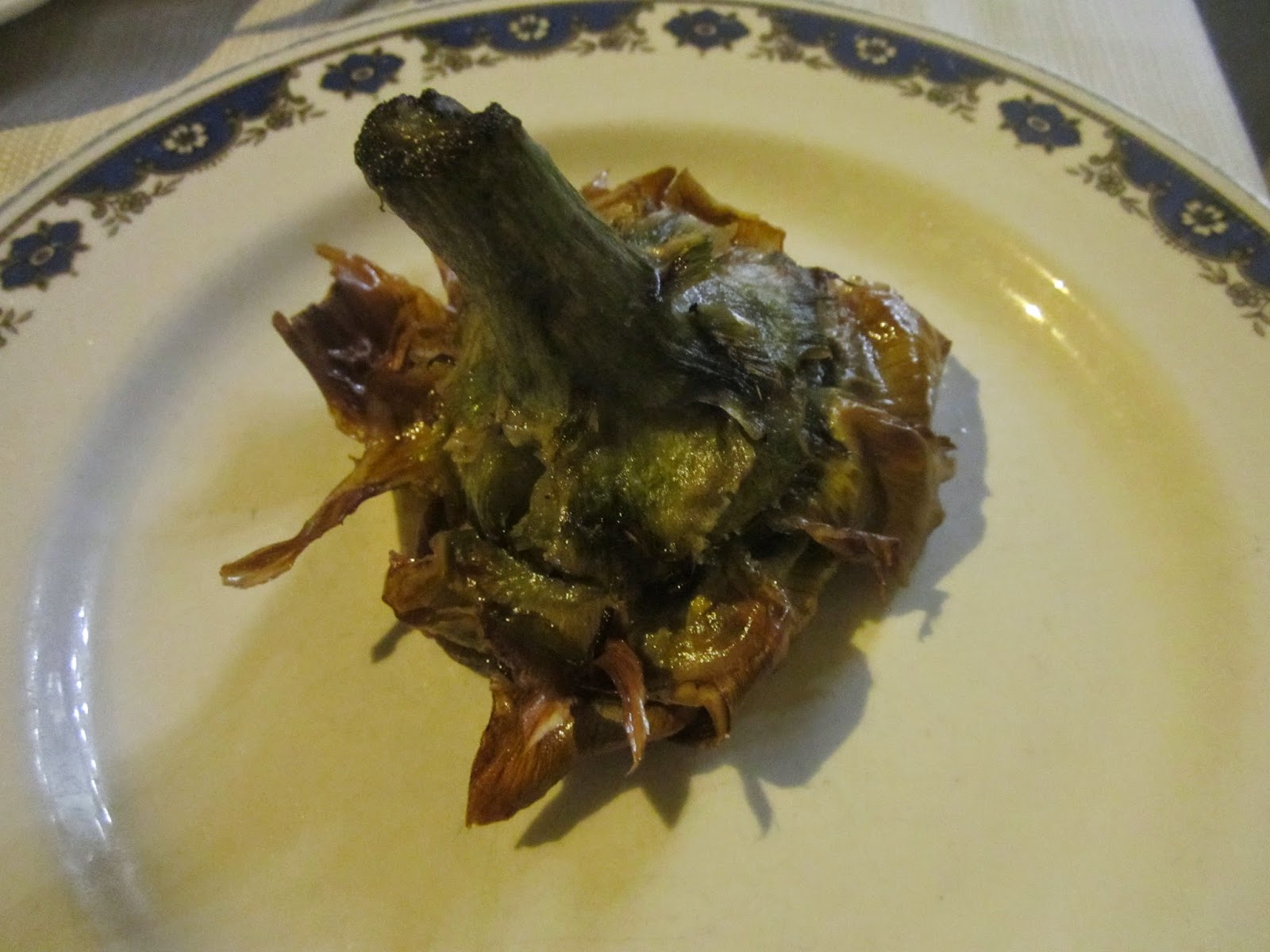
Ragno D’Oro is located a short walk from St Peter’s square, but far enough take away any worries that you might be walking into a tourist trap. The name translates as Golden Spider, according to Google translate. We started with a very Roman selection of appetisers- fried courgette flowers, a globe artichoke to share and salt cod fritters, as well as some prosciutto and focaccia. I enjoyed it all, and despite the high proportion of deep-fried items, it didn’t feel too heavy.

To follow, I had a risotto alla crema di scampi, and Adam had spaghetti al frutto di mare. They were both gorgeous, but exceptionally rich- Adam struggled to finish his spaghetti due to the sheer quantity of butter in the dish. I found my risotto more manageable, but then I do have a love of fatty and dairy laden food.


Like the previous night, we didn’t have dessert at the restaurant, but went to a gelateria. This time we went to Fatamorgana, which is in the Prati area. They have a large selection of flavours, including a chocolate a tobacco concoction called ‘Kentucky’. Sticking to the rich food theme, I had a scoop of Venezuelan chocolate and a scoop of gianduja, whereas Adam went for a lighter option of strawberry and lemon sorbets.


Saturday, 13 September 2014

Roman Holiday: Part I

I've just come home from my fourth trip to Rome, it's been my best trip there so far for a number of reasons, one of which was the food. Any holiday I take I centres around food as much as possible, and this time I was with my partner who is as interested in eating as much as I am, and doesn't seem to mind searching for the nicest looking deli or pasticceria, even if it is 11am and we haven't had breakfast yet.

Our first meal was surprisingly good- I say surprisingly because it was at about 3pm on a Sunday, and most places that aren't tourist traps would be closed at this time. We ended up stopping at the first place that was actually open, which looked unassuming, but turned out to serve very decent, simple food- I had a very tasty bucatini all'amatriciana, and Adam had spaghetti alle vongole. Unfortunately, my head wasn't really in food critic mode, I was too hungry and too tired from the trip to really assess what I was eating, or take down the name of the restaurant.

A nap and a walk into the centre of the city later, we were ready for our next meal. This time we could be more discerning where we went, as the restaurants had re-opened for evening service.  We found ourselves at Da Baffetto, which is a very popular pizzeria with both locals and tourists. It seems to make an appearance in every travel guide to Rome, and in every list of top 10 pizzerias in the city. We joined a queue for a table, where I could take some pictures of the exterior:


The queue moved quickly, and were seated right next to the wood burning oven- not great from a comfort perspective-it was a very warm evening-but watching the 3 chefs prepare the pizzas was good entertainment.


The pizza was as Roman pizza should be- thin, crispy and slightly blistered from the oven.
We didn't stay for pudding, instead continued our walk, stopping of for gelato at Cremaria Monteforte, which is a few moments away from the Pantheon. I went for a rather Middle-Eastern inspired combination of rose and pistachio ice creams, and Adam opted for lemon sorbet.


The rose ice-cream was delicious, flavoursome without reminding me of bath products, which rose flavoured things often do.